
Mobile Patrol vs On-Site Security Guard: Which Fits Your Site?
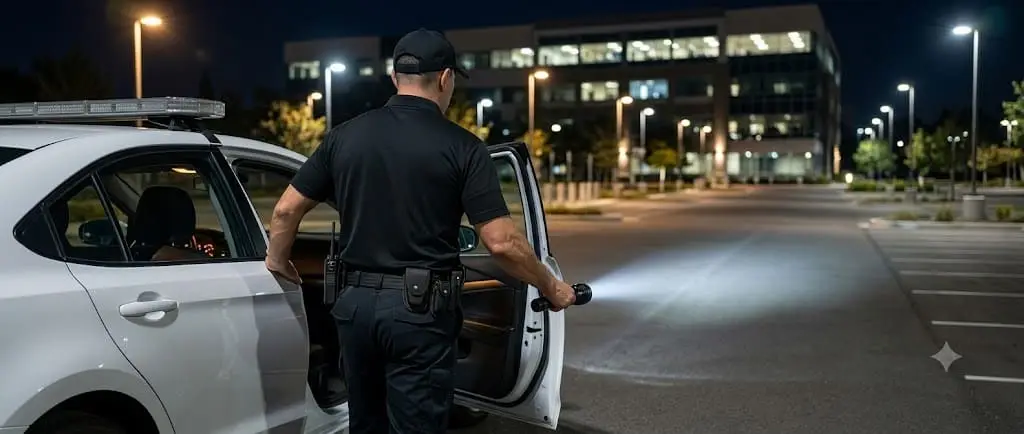
An on-site security guard stays at one property for the whole shift and can act the moment something happens, so it suits busy, high-value or high-risk sites. Mobile patrol sends a licensed officer in a marked vehicle at random times, usually at lower cost, so it suits quiet, vacant or neighbouring sites. Many properties use both.
Key facts
- An on-site guard is posted at one property for the whole shift and can respond immediately.
- A mobile patrol officer visits at random times in a marked vehicle, so response depends on where the patrol is on its route.
- Mobile patrol usually costs less than an on-site guard because patrol time is shared across sites.
- Security guard agencies in Ontario are required to hire only licensed security guards.
- A business selling security guard services cannot hold a licence in Ontario unless it is insured for the prescribed kinds and amounts of liability.
- Many sites combine both options, with a guard when the property is busy and mobile patrol when it is quiet.
Which coverage fits your site? Decision table
The table below matches seven common Ontario site types to the option we would usually start with.
| Your site | What is at stake | How fast someone must act | Where we would start |
|---|---|---|---|
| Condo or residential lobby | Residents, visitors and deliveries all day | A person at the desk all shift | On-site guard |
| Construction site in progress | Equipment and materials left on site | On the spot, as it happens | On-site guard |
| Retail store or plaza | Theft while customers are inside | Throughout trading hours | On-site guard |
| Empty or closed building | Break-ins, leaks or damage | Regular checks and alarm calls | Mobile patrol |
| Warehouse or yard after hours | Gates and doors on a quiet night | Unpredictable visits and alarm calls | Mobile patrol |
| Several properties close together | Differs from one site to the next | Visible checks everywhere, closer cover where incidents cluster | Both: patrol across the group, a guard at the busiest site |
| Event | Crowds and entry points | Present from start to finish | On-site guard |
Below, we compare response, cost, deterrence and proof, so you know what you are buying before you ask for a written quote.
What is the difference between a mobile patrol and an on-site guard?
An on-site guard is a fixed post for the whole shift, while mobile patrol is a series of random visits by an officer who then moves on to other sites. Which suits you depends on your risks, your budget and how quickly you need someone to respond.
What is an on-site security guard?
An on-site guard, also called a static guard, is posted at one property for the full shift. They might staff a lobby desk, watch a gate, patrol the building on foot or monitor CCTV. Because they never leave, they are already there when something happens.
What does a mobile patrol officer do?
A mobile patrol officer drives a marked vehicle to your property on a randomized schedule, so visits come at different times each shift. They inspect doors, gates, lighting and parking areas, deal with anything they find, and report back. Our patrol officers are licensed under Ontario’s Private Security and Investigative Services Act (PSISA). The Government of Ontario states: “Security guard or private investigator agencies are required to only hire licensed security guards or private investigators.”
What are patrol units?
A patrol unit is the marked vehicle and its officer together, travelling a route between sites. The vehicle is part of the deterrent, so when you buy patrol you are buying visible visits rather than a fixed post. Some providers fit patrol vehicles with GPS tracking, so it is worth asking whether yours does and whether you can see the visit times.
Mobile patrol vs on-site guard: side by side
An on-site guard gives you constant presence at one property, while mobile patrol gives you regular, unpredictable visits at a lower cost because patrol time is shared across sites.
| On-site guard | Mobile patrol | |
|---|---|---|
| Presence | Stays at your property for the whole shift, at a lobby desk, gate or on foot | Visits at random times during the shift in a marked vehicle |
| Cost | Higher: you pay for every hour the guard is on site | Lower, because patrol time is shared across sites (prices depend on hours, site and risk) |
| Response | Immediate, already on site | Depends on where the officer is on the route at that moment |
| Customer service | Greets visitors, manages access and answers questions in person | Minimal, mainly checks and reports |
| Best deterrent for | Busy sites and high-value assets | Quiet sites and after-hours checks |
| Reporting | Daily activity log | A report for every visit |
| Licensing | Agencies may hire only licensed guards under PSISA | The same rule applies |
Each option has a limit. A guard costs more because of those paid hours, and a patrol cannot be in two places at once. That is why the answer is often both, as the section on combining them explains.
How fast can each one respond to an incident?
An on-site guard responds fastest because they are already on the property and can act in real time. A mobile patrol’s response time depends on where the officer is on the route when the call comes in.
Patrol still has a clear role with alarms. The same officer who does your checks can respond to alarm calls at your site, checking out the alarm before you send staff or call the police. Before you choose, ask any provider:
- Is 24/7 dispatch in place, and who answers overnight?
- How many sites share each patrol route?
- What is the usual response window for alarm calls at your address?
- Will you receive an incident report after every response?
Which costs more, a mobile patrol or an on-site guard?
An on-site guard usually costs more, because you pay for every hour the guard is at your property, while mobile patrol time is shared across several sites. How much lower patrol comes in depends on your site, so we do not quote a figure here.
We do not publish fixed rates. As of November 2026, every quote we give is built from your hours, your site and your risks, and rates may change over time. Whichever option you compare, get a clear, written quote that shows what is included and states any extra charges up front.
Risk level shapes the decision as much as price. A quiet, low-risk property may not need someone all shift, while a site that needs a person to see and act in real time often justifies a guard.
Are security guards tax deductible for your business?
For most businesses, security services for a business property are an operating cost, but your accountant should confirm how they apply to you. The Canada Revenue Agency explains that you can generally deduct reasonable expenses you incur to earn business income. Keep your written quote, invoices and reports together so the cost is easy to document.
Which deters crime better, and what proof do you get?
It depends on the deterrence you need: an on-site guard gives constant visible presence, while mobile patrol relies on visits nobody can predict. Both leave you written proof, in different formats.
Deterrence
An on-site guard is visible for the whole shift, which suits busy sites where people come and go and someone needs to be at the door. Our patrols arrive in a marked vehicle with unpredictable timing across your properties, to maximize deterrence. Patrol gives you visits rather than constant presence, so it suits quieter properties.
Reports and logs
Our on-site guards keep a daily activity log for the shift, and our patrol officers file a report for every visit, plus an incident report when something happens. Ask to see a sample report before you sign. A useful one shows:
- The time of the visit or the shift
- The areas checked, such as doors, gates, lighting and parking
- Anything found, however minor
- The action taken, and who was told
When does an on-site guard make sense?
An on-site guard makes sense wherever a person needs to be present for the whole shift to greet, watch or stop people in real time. Our security officers are licensed under Ontario’s PSISA. These are the site types where we see that need most:
- Residential and condo lobbies: a concierge security guard at the front desk greets residents and visitors and controls who comes in.
- Construction sites: costly equipment, materials or a fire watch requirement call for construction site security on site all shift, not occasional visits.
- Retail stores and plazas: theft happens during business hours, so a visible officer matters most when customers are inside.
- Shelters and supportive housing: staff need steady, on-site support throughout the shift.
- Events: crowd management and entry control only work with people in place.
When does mobile patrol make sense?
Mobile patrol makes sense when a site needs regular, visible checks but not a person standing there for the whole shift. In our experience, these are the sites where patrol fits best:
- Vacant or closed buildings: regular checks for break-ins, leaks or damage.
- Industrial units, warehouses and yards: places that are quiet overnight, where a marked vehicle and a walk around gates, doors and lighting does the job.
- Several sites close together: a portfolio of plazas or townhouse complexes, where one officer’s route can cover them all.
- Alarm response: alarm systems tell you something has triggered, and the patrol officer confirms whether it is real.
- Tighter budgets: full-time coverage is not affordable, but you still need visible, reported checks.
Which should you choose for your site?
Choose an on-site guard when your site is busy, high-risk or needs someone to respond immediately, and choose mobile patrol when it is quiet, vacant or one of several nearby locations. The decision table at the top of this article gives you a starting option for each site type.
This is a starting point, not a rule. If your site sits between two rows, call us on (647) 637-1116 or request a quote, and we will talk it through with you.
Can you combine mobile patrol and an on-site guard?
Yes, many properties combine the two: a guard on site when the property is busy, and mobile patrol when it is quiet. This is often called a hybrid or layered approach, and both can sit under one plan.
Worked example: a partly vacant plaza
Take a partly vacant Ontario plaza, where some units are empty, the rest trade during the day, and one entrance carries most of the customers and deliveries. Here is how we would set up coverage for it.
- Daytime: an on-site guard at the busiest entrance during trading hours, greeting visitors and keeping a daily activity log.
- Overnight: mobile patrol visits at random times after closing, checking the doors of the vacant units, the gates, the lighting and the parking areas.
- Alarms: the same patrol officer checks out any alarm at the plaza before you send staff or call the police.
Each overnight visit report records the four items from the checklist above:
- The time of the visit.
- The areas checked, such as the doors of the empty units, the gates, the lighting and the parking areas.
- Anything found, however minor, such as a light out over a rear door or a door left unlocked.
- The action taken, and who was told.
You can also start the other way round. Begin with patrol, review a month of patrol reports, then add on-site cover only where incidents cluster, whether that is a time of day or one part of the property. If you add CCTV to the mix, find out who monitors it and who responds when it triggers.
How can a security company help you choose?
A good security company should start by asking about your property, its hours and recent incidents, then recommend coverage to match. The duties should then be written down as site-specific post orders, so everyone knows what the guard or patrol officer checks and when.
Before you sign with any provider, including any of the Toronto security companies you are comparing, check three things:
- Licensing: the agency and its guards are licensed under the Private Security and Investigative Services Act, 2005 (S.O. 2005, c. 34), and the Government of Ontario says agencies must hire only licensed security guards.
- Insurance: under the Private Security and Investigative Services Act, 2005, a business selling security guard services cannot hold a licence unless it is insured for the kinds and amounts of liability prescribed.
- Reports: written reports for every visit or shift.
Our guide to choosing a security guard company in Ontario lists the questions to ask any security agency in Toronto or the GTA. We also have local pages for Vaughan, Mississauga and Brampton.
Not sure which you need?
If you cannot tell whether your site needs a guard on the premises or a patrol, tell us about your property, its hours and what has been happening. We will recommend the coverage that fits, even if that means less than you expected. Call us on (647) 637-1116 or ask for a free quote.
Jason’s Security Inc. offers both options compared here. Our security guard services include on-site guards and concierge security, with officers who greet visitors and control who comes in. We also provide construction site security and mobile patrol with randomized site checks. Tell us about your site and we will give you a clear, written quote.
Frequently asked questions
What does patrol mean in security?
Patrol means an officer moves around a property or a set of properties to check that everything is secure, rather than staying in one spot. On mobile patrol, the officer drives a marked vehicle to each site at random times, checks doors, gates, lighting and parking areas, and reports back.
Do mobile patrol officers in Ontario need a licence?
Yes. The Government of Ontario states that security guard agencies are required to only hire licensed security guards, under the Private Security and Investigative Services Act. The agency itself must also be insured to hold its licence. When comparing providers, ask for licence details and proof of insurance.
Can a mobile patrol officer respond to an alarm at my property?
Yes. Your patrol officer can respond to alarm calls at your site as well as doing scheduled checks. Response time depends on where the patrol is on its route, so ask how 24/7 dispatch works overnight.
Can I start with mobile patrol and switch to an on-site guard later?
Yes. You can start with patrol, review a month of patrol reports and add an on-site guard where incidents cluster. Many properties also combine the two, with a guard for busy hours and patrol for quiet nights or weekends.